Orvieto is a beautiful town bewteen Rome and Assisi.
Orvito is one of the most dramatic hill towns in Italy, perched on a plateau atop huge tufa cliffs. Orvieto has a stunning duomo (cathedral) and its monuments and museums cover millenniums of history starting with the Etruscans. We’ll travel up the hill in a funicular railway. Orvieto is famous for the Eucharistic Miracle and this is its story.
In 1263 a German priest, Peter of Prague, stopped at Bolsena while on a pilgrimage to Rome. He is described as being a pious priest, but one who found it difficult to believe that Christ was actually present in the consecrated Host. While celebrating Holy Mass above the tomb of St. Christina (located in the church named for this martyr), he had barely spoken the words of Consecration when blood started to seep from the consecrated Host and trickle over his hands onto the altar and the corporal.
The priest was immediately confused. At first he attempted to hide the blood, but then he interrupted the Mass and asked to be taken to the neighboring city of Orvieto, the city where Pope Urban IV was then residing.
The Pope listened to the priest's account and absolved him. He then sent emissaries for an immediate investigation. When all the facts were ascertained, he ordered the Bishop of the diocese to bring to Orvieto the Host and the linen cloth bearing the stains of blood. With archbishops, cardinals and other Church dignitaries in attendance, the Pope met the procession and, amid great pomp, had the relics placed in the cathedral. The linen corporal bearing the spots of blood is still reverently enshrined and exhibited in the Cathedral of Orvieto.
It is said that Pope Urban IV was prompted by this miracle to commission St. Thomas Aquinas to compose the Proper for a Mass and an Office honoring the Holy Eucharist as the Body of Christ. One year after the miracle, in August of 1264, Pope Urban IV introduced the saint's composition, and by means of a papal bull instituted the feast of Corpus Christi.
The Basilica of St Francis is where we had the opportunity for Mass in the afternoon, led by our our Franciscan Priest from Sydney Fr. Robert.
The Franciscan monastery and the Lower and Upper Basilicas of Francis of Assisi were begun in honor of this local saint, immediately after his canonization in 1228. Simone di Pucciarello donated the land for the church, a hill at the west side of Assisi, known as "Hill of Hell" where previously criminals were put to death. Today, this hill is called "Hill of Paradise". The foundation stone was laid by Pope Gregory IX on 17 July 1228, although construction may already have been begun. The church was designed and supervised by Brother Elia Bombardone, one of the first followers of St. Francis and the former provincial minister of Syria. The Lower basilica was finished in 1230.
Next was the church of St. Damien. San Damiano is a church with a monastery. It was the first monastery of the Order of Saint Clare, where Saint Clare built her community. Perhaps one of the most significant aspects regarding the church was Saint Francis' encounter with Christ. He had been praying at San Damiano which at the time was a very run down building. Saint Francis saw the figure of Christ crucified come alive and say to him , "Francis, don't you see my house is crumbling apart? Go, then, and restore it!" Afterwards Saint Francis took action to repair San Damiano, although he eventually realized that God's message to him was to restore the Church as a whole rather than literally repair churches such as San Damiano. We saw the Crucifix yesterday in the Basilica.
We visited The Hermitage in the early morning and it was special. the hermitage is built on the site of a simple cave, where St Francis spent hours in prayer and contemplation. You’ll be able to go down into the cave area and experience how small it is. the view from this hermitage was unbelievable.
Today we left Roma and travelled on our way to Assisi. However we had a stop about halfway at Orvieto.It’s one of the most dramatic hill towns in Italy, perched on a plateau atop huge tufa cliffs. Orvieto has a stunning duomo (cathedral) and its monuments and museums cover millenniums of history starting with the Etruscans. We’ll travel up the hill in a funicular railway. Orvieto is famous for the Eucharistic Miracle and this is its story.
In 1263 a German priest, Peter of Prague, stopped at Bolsena while on a pilgrimage to Rome. He is described as being a pious priest, but one who found it difficult to believe that Christ was actually present in the consecrated Host. While celebrating Holy Mass above the tomb of St. Christina (located in the church named for this martyr), he had barely spoken the words of Consecration when blood started to seep from the consecrated Host and trickle over his hands onto the altar and the corporal.
The priest was immediately confused. At first he attempted to hide the blood, but then he interrupted the Mass and asked to be taken to the neighboring city of Orvieto, the city where Pope Urban IV was then residing.
The Pope listened to the priest's account and absolved him. He then sent emissaries for an immediate investigation. When all the facts were ascertained, he ordered the Bishop of the diocese to bring to Orvieto the Host and the linen cloth bearing the stains of blood. With archbishops, cardinals and other Church dignitaries in attendance, the Pope met the procession and, amid great pomp, had the relics placed in the cathedral. The linen corporal bearing the spots of blood is still reverently enshrined and exhibited in the Cathedral of Orvieto.
It is said that Pope Urban IV was prompted by this miracle to commission St. Thomas Aquinas to compose the Proper for a Mass and an Office honoring the Holy Eucharist as the Body of Christ. One year after the miracle, in August of 1264, Pope Urban IV introduced the saint's composition, and by means of a papal bull instituted the feast of Corpus Christi.
We had lunch in Orvieto where we bought pizza slices the size of an iPad for 1.5 euro!
On the BUS and off we go to Assisi. It will be about another 1 ½ hours to Assisi. This is the home of St Francis and St Clare. Some of you might live in a Franciscan parish or know girls who go to St Clare’s at Waverley. St Clare’s is run by the Poor Clare nuns, who were formed by St Clare and St Francis.
First stop is the Basilica of St Mary of the Angels. This is down on the plains of Assisi where St Francis spent much of his life.
Our first stop in Assisi is Santa Maria degli Angeli (Church of St. Mary of the Angels) in Assisi is much venerated as the place of St. Francis' death. Inside the grand Baroque basilica are two small, humble structures: the Capella del Transito and the Porziuncola. The Porziuncola is a chapel obtained from the Benedictines and restored by St. Francis himself. In it he founded the order of Friars Minor that would later be known as the Franciscans. It was also here that St. Clare embarked on her monastic life on March 28, 1211.
There was also half an hour of fireworks tonight celebrating the feats day of St Clare.
I will upload as many of our photos as possible on my next post,
Ciao.
Declan
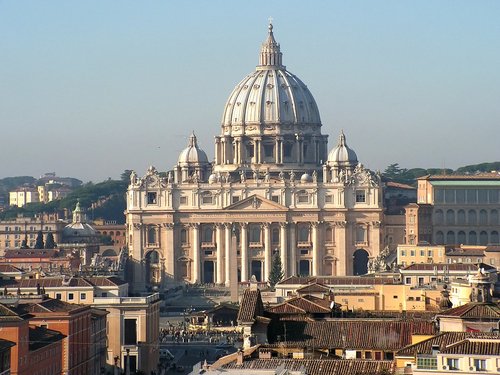
Today we started with mass at THE MAIN ALTER AT ST. PETER'S BASILICA!!!!!!!! IT WAS AMAZING.
Emperor Constantine, the first Christian emperor of Rome, ordered the building of a basilica on Vatican Hill. The location was symbolic: this was the place where Saint Peter, the chief apostle, was buried in 64 A.D. A small shrine already existed on the site but it was replaced by this new church, completed around 349 A.D.
The building itself is truly impressive. The largest church in the world, it has a 218 meter long nave. The basilica's dome is the world's largest measuring 42m in diameter and reaching 138 meter high. The interior, which includes 45 altars, is decorated by many famous artists. Some of the most important works in the church are the Pietà by Michelangelo, the papal altar by Bernini, the Throne of St. Peter - also by Bernini - and the Monument to the Stuarts by Canova.
We also climbed to the top of St. Peter's Dome to see the best view of Rome (all 551 steps).
The Swiss Guards
Near the entrance of the Basilica you will probably encounter some of the famous Swiss guards. Since 1506 when Pope Julius II invited Helvetian soldiers to join the small Vatican army, they have been the guards of the Vatican and the pope in particular. All entrants to the army must be Swiss, Catholic and they must take the oath of loyalty to the Pope. This oath is taken May 26th, to commemorate the sacking of Rome on the same day in 1527 when Swiss guards protected Pope Clement VII during his escape to Castel Sant'Angelo. Of the 189 guards, only 42 survived.
The first stopafter that is the Sistine Chapel. It will be very crowded and the hall leading to the Chapel will also be wall to wall people. Watch out for each other and make sure your money, bags and wallet are being carried safely.
After spending half the day At St. Peters we went on a trip around rome seeing the major sites.
The Circus Maximus was occasionally used for events such as processions or gladiator combats, but on most days only chariot races were held here. The races themselves were wildly popular with people fanatically supporting one of the four factions: red, white, green and blue representing summer, winter, spring and autumn respectively. Bets were laid on one of the factions and supporters of the different factions often clashed, sometimes resulting in deaths among the spectators. The last race at the Circus Maximus was held in AD 549, almost a millennium after the first races were held at this location. Today only the layout of the original circus can be seen in what is now a large grassland. Most of the original structure has been used as building material for medieval and Renaissance constructions.
The Roman Forum was so looted for building materials during late antiquity and the Middle Ages that there appears, at first sight, to be little left. The Roman Forum was not simply the core of an ancient city; for many it was the centre of the universe. From the birth of the empire under Augustus in 31BC, and for nearly 500 years thereafter, Rome ruled most of what we call the civilised world. From Scotland to the Sahara, from Gibraltar to the Euphrates, the Roman Empire was in control. It ruled from here, these five acres controlling the known world, setting in place legal and military systems, and giving the word ‘forum’ to our language as a place of debate, discussion and decision. It was to the Forum that Julius Caesar moved his residence in 45BC. It was the main marketplace, the business district and the town hall. It was the seat of government and the law courts.
The Circus Maximus was occasionally used for events such as processions or gladiator combats, but on most days only chariot races were held here. The races themselves were wildly popular with people fanatically supporting one of the four factions: red, white, green and blue representing summer, winter, spring and autumn respectively. Bets were laid on one of the factions and supporters of the different factions often clashed, sometimes resulting in deaths among the spectators. The last race at the Circus Maximus was held in AD 549, almost a millennium after the first races were held at this location. Today only the layout of the original circus can be seen in what is now a large grassland. Most of the original structure has been used as building material for medieval and Renaissance constructions.
The Roman Forum
The Roman Forum was so looted for building materials during late antiquity and the Middle Ages that there appears, at first sight, to be little left. The Roman Forum was not simply the core of an ancient city; for many it was the centre of the universe. From the birth of the empire under Augustus in 31BC, and for nearly 500 years thereafter, Rome ruled most of what we call the civilised world. From Scotland to the Sahara, from Gibraltar to the Euphrates, the Roman Empire was in control. It ruled from here, these five acres controlling the known world, setting in place legal and military systems, and giving the word ‘forum’ to our language as a place of debate, discussion and decision. It was to the Forum that Julius Caesar moved his residence in 45BC. It was the main marketplace, the business district and the town hall. It was the seat of government and the law courts.
We also went to the Trevi fountain, Th Piazza Novana andThe Spainish Steps.